 The world has suffered from a number of adverse supply shocks in recent years. First there was the credit supply shock of 2007–9 that led to a default on mortgages, a collapse in confidence in the banking system, the drying up of the inter-bank market, the freezing of lending and a global economic contraction. Then there was the COVID-19 pandemic. This shock to the the global economy led to a a fall in output and breaks in supply chains. As recovery took place, supply-side difficulties led to a surge in inflation.
Then there was the Russian invasion of Ukraine. This shock to energy and grain supplies led to rises in fuel and food prices: a cost-push inflationary shock. More recently, the closing of the Strait of Hormuz has cut off an important supply route and again sent fuel and other other prices rising.
These supply-side shocks create a dilemma for central banks. They push up inflation, but push output and employment down – a situation of ‘stagflation’.
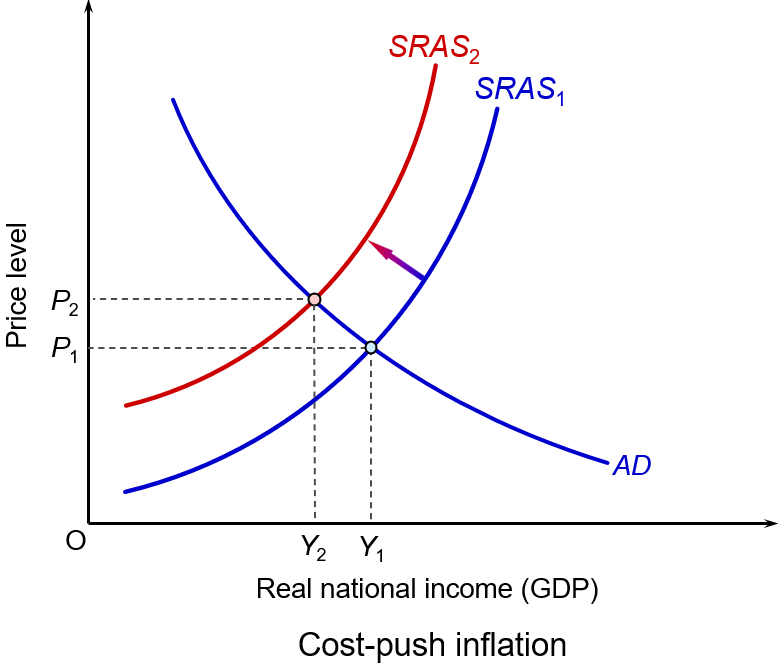 This can be illustrated with a simple aggregate demand and supply diagram. The shock shifts the aggregate supply curve upwards to the left, illustrated by the move from SRAS1 to SRAS2. The price level rises to P2 and GDP falls to Y2.
But central bank policy is designed to affect aggregate demand, not aggregate supply. If it raises interest rates, aggregate demand will shift to the left. The price level will fall (or at least the rate of inflation will fall), but output will fall further. If it cuts interest rates, aggregate demand will shift to the right. This will help to curtail, or even reverse, the fall in GDP, but will lead to even higher prices.
For countries where their central bank has a simple inflation mandate (e.g. keeping inflation close to 2%), sticking to this target in the short term would result in higher interest rates, lower economic growth and higher unemployment – and possibly even a recession. In such cases, central banks tend to project forward beyond the short-term shock and set interest rates to target inflation in a few months’ time. Indeed, many central banks do explicitly target inflation in the medium term (1 or 2 years) rather than the short term.
 Central banks, such as the US Federal Reserve Bank, which have a dual mandate of targeting inflation but also maximising employment, the trade-off between these two objectives can be stark. Getting the inflation down requires a higher rate of interest; maximising employment in the face of an adverse supply shock requires a lower rate of interest.
The short-term economic costs, let alone the human costs if the shock involves a war, can be great. People may suffer extreme hardship. The cost to the US Treasury of the first six weeks of the Iran war were estimated by the Pentagon to be some $29bn1 – which translates into higher taxes for US residents, lower government spending on non-war related items, higher government borrowing or some combination of the three. Other estimates put the cost to the US taxpayer as much higher – up to $1 trillion over the longer term.2 Then there are the costs to consumers of higher fuel and other prices, estimated at around $410 per month.3
The costs to Iranian citizens will be much higher in terms of war damage and loss of livelihood, let alone the suffering and loss of life. Then there are the costs to the rest of the world from higher prices of fuel, fertilisers and various industrial materials that are normally shipped through the Strait of Hormuz.
Long-term economic gain?
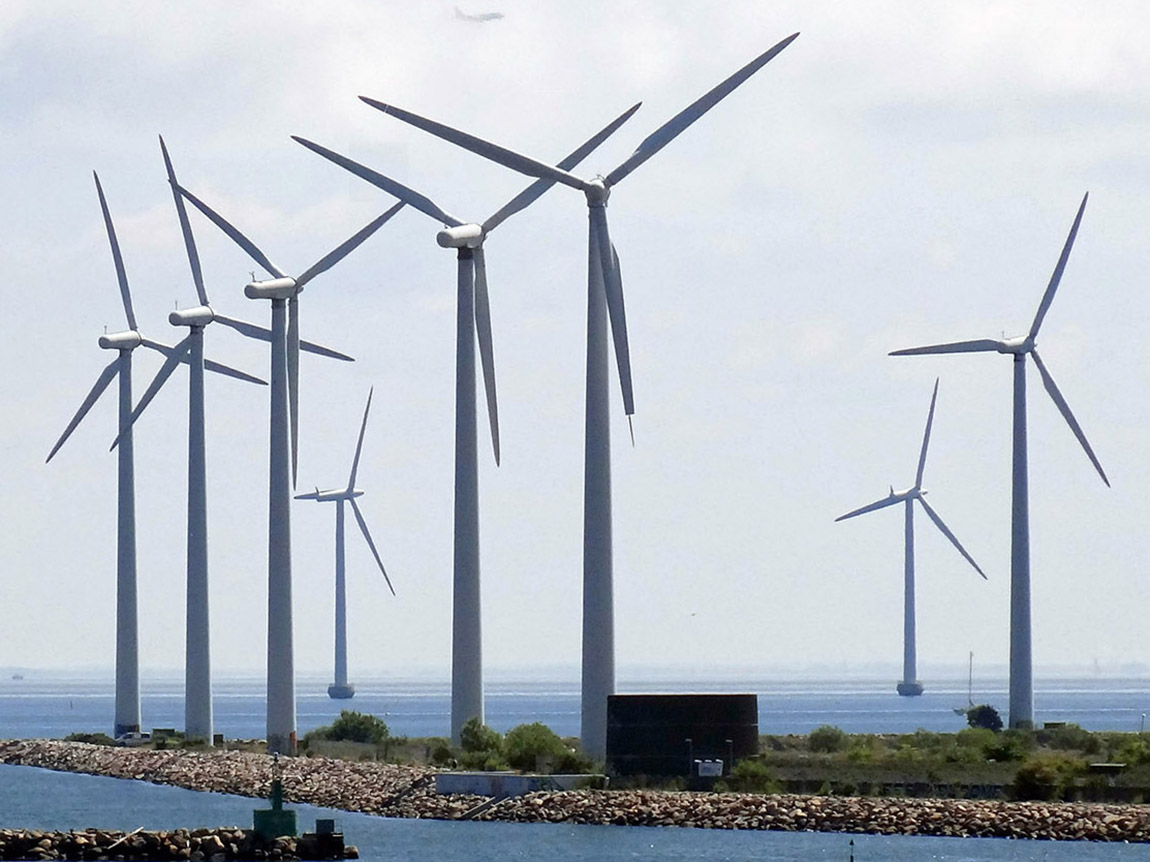 Supply shocks often expose economic vulnerabilities that can later be addressed, making supply chains more diverse and more resilient. They can give a boost to alternative technologies, such as a switch from fossil-fuels to green energy.
After the 2007–9 financial crisis, banking systems were made more robust under the Basel III system. Capital and liquidity requirements were increased and bank leverage was decreased. Many countries, such as the UK, introduced ‘ringfencing’ to separate retail banking from the riskier investment banking. This increased confidence in the banking system.
The COVID-19 pandemic gave a boost to working remotely and the establishment of more flexible work patterns. What was a necessity during lockdowns, was seen as an effective model by many companies. Fully remote or hybrid working became commonplace for many jobs that were previously done in the office. Time has allowed employers to find the best balance of in-office and remote working, with the optimum balance often varying by type of job being performed.
The rising price of oil and gas following the Russian invasion of Ukraine in February 2022, saw many countries that had been reliant on imports from Russia, accelerating their efforts to switch to renewable energy. Supply chains were re-examined and there was a move towards ‘re-shoring’, ‘near-shoring’, or ‘friend-shoring’: that is, obtaining supplies from countries that are nearer and/or more reliable as trading partners.
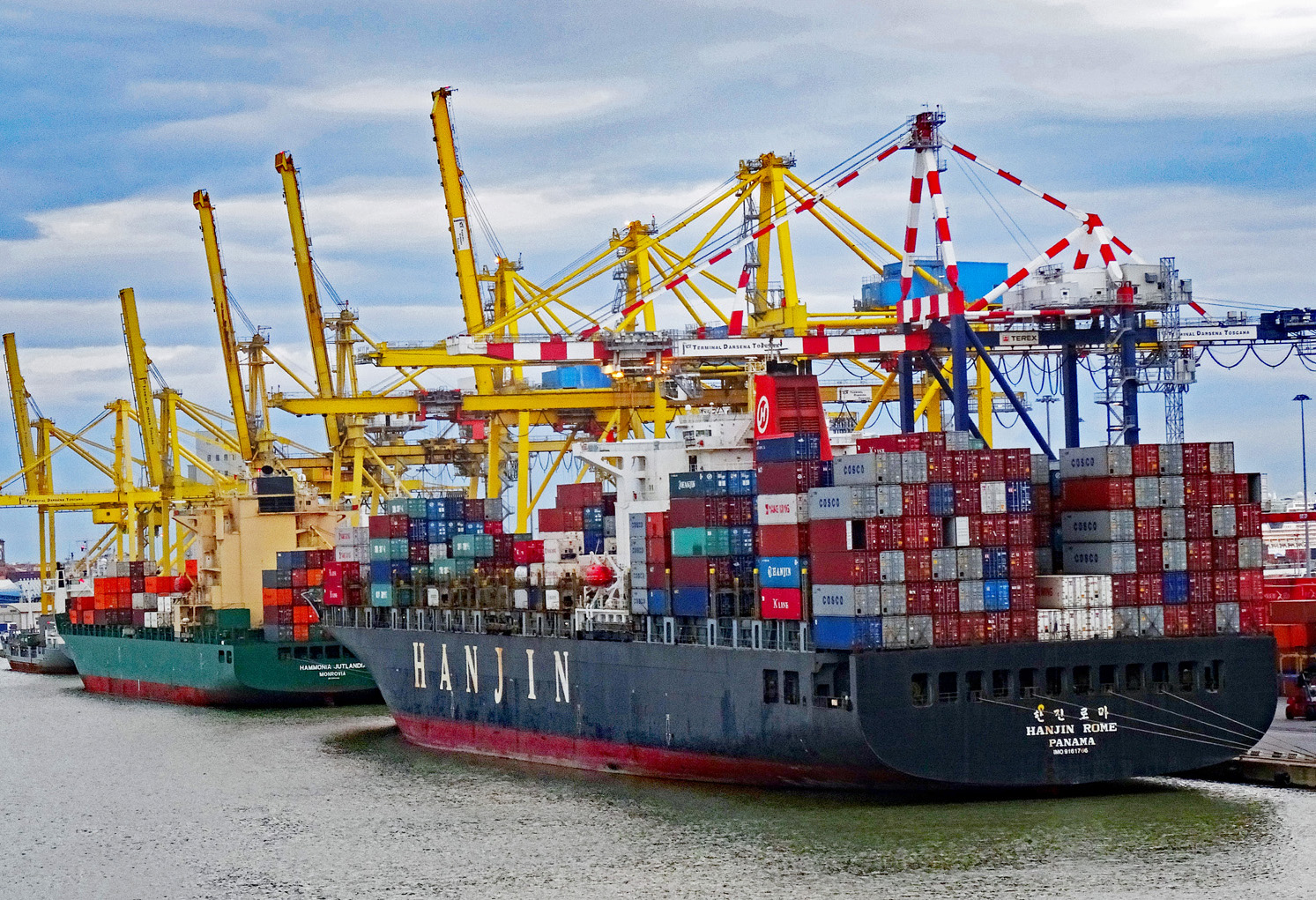 This approach was further boosted by the extensive tariffs imposed by the Trump second administration. One of the responses to the higher tariffs was to seek markets, both for exports and imports, away from the USA. To the extent that there is ‘re-shoring’ (substituting exports and imports for production and consumption within the country), then this amounts to deglobalisation. If this represents a move from low-cost to high-cost production and is contrary to the law of comparative advantage, then there will be a net economic loss. If, however, the reduction in risk of disruption and the boost to domestic industries allows a reduction in costs, there could be a net gain.
The most recent example of the Iran war has led many countries to reconsider sources of supply and to make their supply chains more robust and less risky. Gulf countries are considering expanding their pipeline network to avoid the Strait of Hormuz. For other countries, it is providing a further boost to green energy. Increased investment in the renewable sector will help to bring down costs and make countries less vulnerable to future conflicts involving oil-producing countries or sea passages.
To summarise: if initially adverse supply-side shocks cause a diversification and strengthening of supply chains, a diversification of energy sources, accelerated technological innovation and the adoption of new more efficient techniques, the long-term supply-side effects could be positive. Pain today for gain tomorrow?
But the short run comes before the long run and today’s costs are real and mounting. A shock may stimulate a positive response, but the current shock is persisting, and forecasts are getting more dire by the day. And even when the Iran war is over, there may be more shocks around the corner – ‘unknown unknowns’. As Keynes said: ‘In the long run we’re all dead’.
References
- Pentagon’s estimate for Iran war grows to $29B
Politico, Mark Sweney (12/5/26)
- World Politics The Iran war could cost the American taxpayer $1 trillion, says Harvard academic
CNBC, Joseph Wilkins (14/4/26)
- The Economic Costs of the Iran War
American Enterprise Institute, Roger Pielke Jr. (2/4/26)
Articles
Questions
- What policies have central banks pursued during the Iran war?
- Paint an optimistic scenario for the global economy five years hence.
- Paint a pessimistic scenario for the global economy five years hence.
- Compare the sources of supply of oil and gas for Europe directly prior to the Iran war with those directly prior to the Russian invasion of Ukraine.
- Compare the relative merits of globalisation and deglobalisation. Does this depend on the nature of globalisation and deglobalisation?
 ‘Employment has been strong, but productivity and real wages have been flat.’ This is one of the key observations in a new OECD report on the state of the UK economy. If real incomes for the majority of people are to be raised, then labour productivity must rise.
For many years, the UK has had a lower productivity (in terms of output per hour worked) than most other developed countries, with the exception of Japan. But from 1980 to the mid 2000s, the gap was gradually narrowing. Since then, however, the gap has been widening again. This is illustrated in Chart 1, which shows countries’ productivity relative to the UK’s (with the UK set at 100). (Click here for a PowerPoint.)
Compared with the UK, GDP per hour worked in 2013 (the latest data available) was 28% higher in France, 29% higher in Germany and 30% higher in the USA. What is more, GDP per hour worked 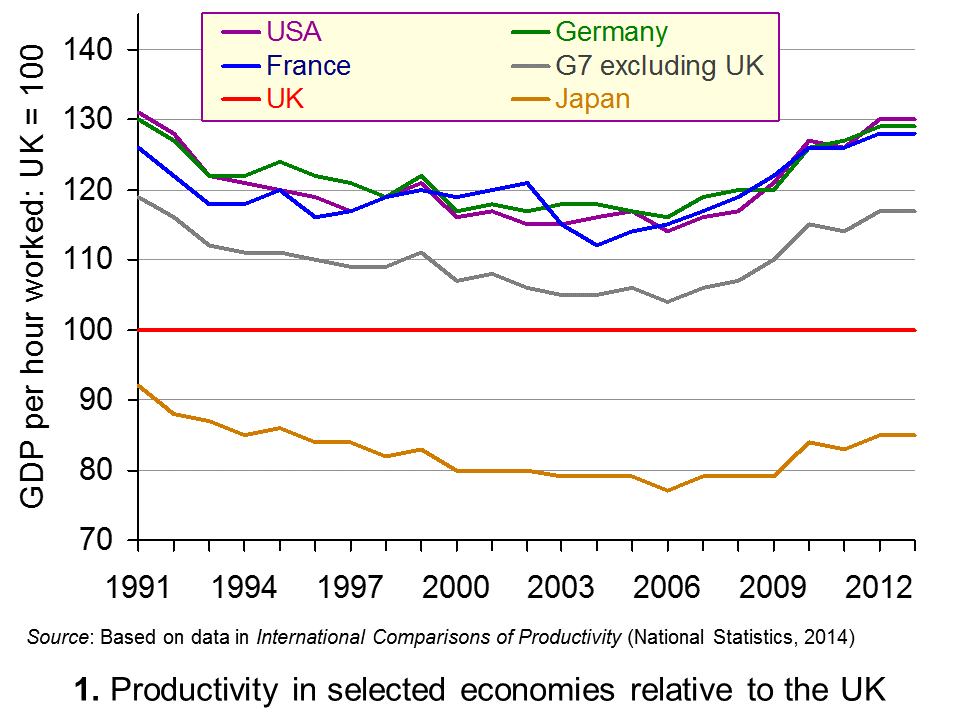 and GDP per capita in the UK fell by 3.8% and 6.1% respectively after the financial crisis of 2007/8 (see the green and grey lines in Chart 2). And while both indicators began rising after 2009, they were still both below their 2007 levels in 2013. Average real wages also fell after 2007 but, unlike the other two indicators, kept on falling and by 2013 were 4% below their 2007 levels, as the red line in Chart 2 shows. (Click here for a PowerPoint.)
Although productivity and even real wages are rising again, the rate of increase is slow. If productivity is to rise, there must be investment. 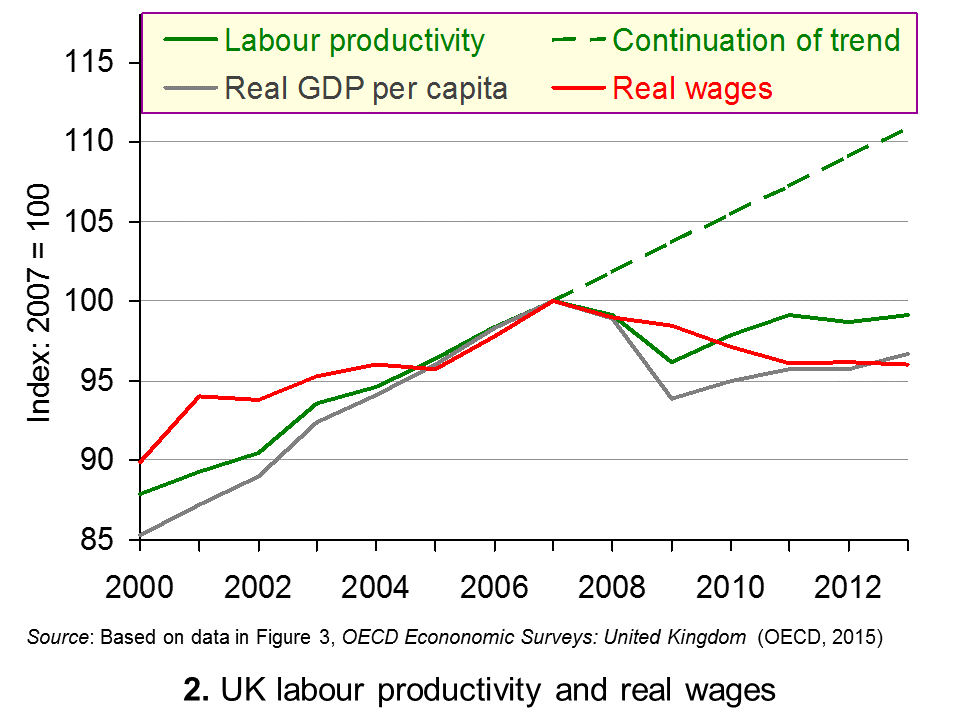 This could be in physical capital, human capital or, preferably, both. But for many years the UK has had a lower rate of investment than other countries, as Chart 3 shows. (Click here for a PowerPoint.) This chart measures investment in fixed capital as a percentage of GDP.
So how can investment be encouraged? Faster growth will encourage greater investment through the accelerator effect, but such an effect could well be short-lived as firms seek to re-equip but may be cautious about committing to increasing capacity. What is crucial here is maintaining 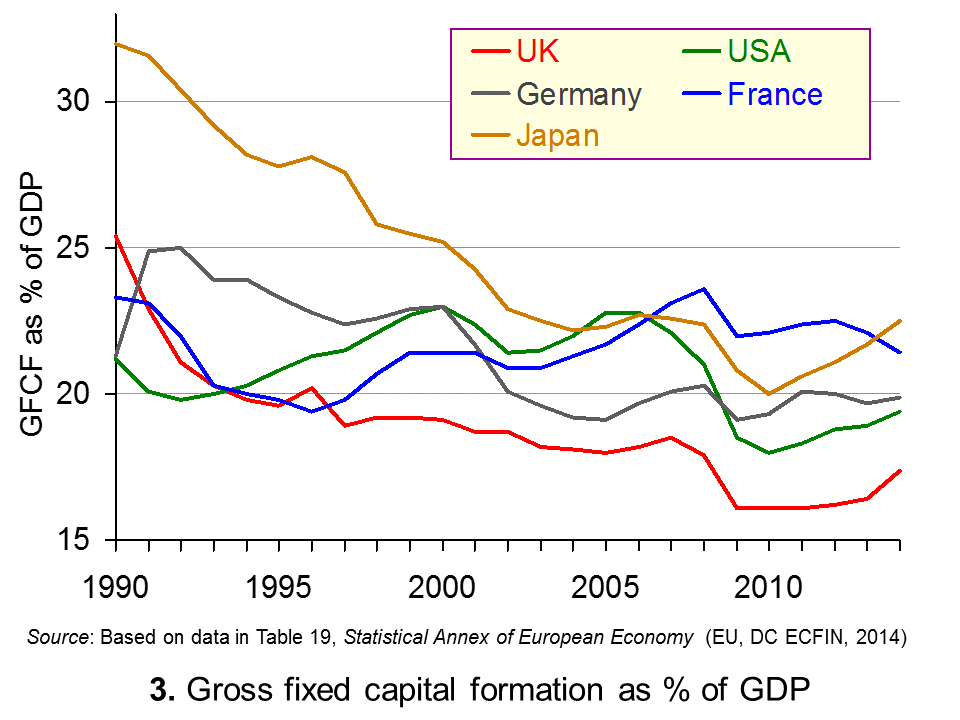 high degrees of business confidence over an extended period of time.
More fundamentally, there are structural problems that need tackling. One is the poor state of infrastructure. This is a problem not just in the UK, but in many developed countries, which cut back on public and private investment in transport, communications and energy infrastructure in an attempt to reduce government deficits after the financial crisis. Another is the low level of skills of many workers. Greater investment in training and apprenticeships would help here.
Then there is the question of access to finance. Although interest rates are very low, banks are cautious about granting long-term loans to business. Since the financial crisis banks have become much more risk averse and long-term loans, by their nature, are relatively risky. Government initiatives to provide finance to private companies may help here. For example the government has just announced a Help to Grow scheme which will provide support for 500 small firms each year through the new British Business Bank, which will provide investment loans and also grants on a match funding basis for new investment.
Articles
OECD: UK must fix productivity Economia, Oliver Griffin (25/2/15)
The UK’s productivity puzzle BBC News, Lina Yueh (24/2/15)
OECD warns UK must fix productivity problem to raise living standards The Guardian, Katie Allen (24/2/15)
Britain must boost productivity to complete post-crisis recovery, says OECD International Business Times, Ian Silvera (24/2/15)
OECD urges UK to loosen immigration controls on skilled workers Financial Times, Emily Cadman and Helen Warrell (24/2/15)
Report
OECD Economic Surveys, United Kingdom: Overview OECD (February 2015)
OECD Economic Surveys, United Kingdom: Full report OECD (February 2015)
Questions
- In what ways can productivity be measured? What are the relative merits of using the different measures?
- Why has the UK’s productivity lagged behind other industrialised countries?
- What is the relationship between income inequality and labour productivity?
- Why has UK investment been lower than in other industrialised countries?
- What are zombie firms? How does the problem of zombie firms in the UK compare with that in other countries? Explain the differences.
- What policies can be pursued to increased labour productivity?
- What difficulties are there in introducing effective policies to tackle low productivity?
- Should immigration controls be lifted to tackle the problem of a shortage of skilled workers?
 Now here’s a gloomy article from Robert Peston. He’s been looking at investors’ views about the coming years and sees a general pessimism about the prospects for long-term economic growth. And that pessimism is becoming deeper.
It is true that both the UK and the USA have recorded reasonable growth rates in recent months and do seem, at least on the surface, to be recovering from recession. But, according to investor behaviour, they:
seem to be saying, in how they place their money, that the UK’s and USA’s current reasonably rapid growth will turn out to be a short-lived period of catch-up, following the deep recession of 2008-9.
So what is it about investor behaviour that implies a deep pessimism and are investors right to be pessimistic? The article explores these issues. It does also look at an alternative explanation that investors may merely be being cautious until a clearer picture emerges about long-term growth prospects – which may turn out to be better that many currently now predict.
The article finishes by looking at a possible solution to the problem (if you regard low or zero growth as a problem). That would be for the government to ‘throw money at investment in infrastructure – to generate both short-term growth and enhance long-term productive potential.’
Note that Elizabeth also looks at this article in her blog The end of growth in the west?.
The end of growth in the West? BBC News, Robert Peston (26/9/14)
Questions
- What is meant by the ’25-year yield curve for government bonds’? Why does this yield curve imply a deep level of business pessimism about the long-term prospects for UK economic growth?
- What are the determinants of long-term economic growth?
- Looking at these determinants, which ones suggest that long-term economic growth may be low?
- Are there any determinants which might suggest that economic growth will be maintained over the long term at historical levels of around 2.6%?
- Do demand-side policies affect potential GDP and, if so, how?
- What policies could government pursue to increase the rate of growth in potential GDP?
- What current ‘dramas’ affecting the world economy could have long-term implications for economic growth? How does uncertainty about the long-term implications for the global economy of such dramas itself affect economic growth?
- Is long-term growth in real GDP an appropriate indicator of (a) economic development and (b) long-term growth in general well-being?
On the 24th May the new collation government released details of its plan to make £6.2 billion of savings (see HM Treasury press release). As part of this package, The Department for Business, Innovation and Skills (BIS) – headed by Business Secretary, Vince Cable – will make savings of £836 million, equivalent to 3.9% of its budget. One of the areas identified by BIS for ‘savings’ is the higher education budget, which will lose £200 million. Also targeted are the Regional Development Agencies (RDAs) in England. These are the strategic drivers of economic development in the English regions. They will lose £74 million from BIS as well as a further £196 million from other government departments.
So what is the Department for Business, Innovation and Skills charged with doing? Well, according to the BIS website it is charged with
…building a dynamic and competitive UK economy by: creating the conditions for business success; promoting innovation, enterprise and science; and giving everyone the skills and opportunities to succeed. To achieve this it will foster world-class universities and promote an open global economy.
In describing what BIS does, BIS states that it
…brings all of the levers of the economy together in one place. Our policy areas – from skills and higher education to innovation and science to business and trade – can all help to drive growth.
In other words, the BIS is intended to be a key player in affecting the UK’s long-term rate of economic growth. Since 1948 the average annual rate of growth of the UK economy, as measured by constant-price GDP (real GDP), is 2.4%. Of course, a key question is how we might do better. But, there is a significant disagreement amongst economists about the role that government should play in advancing long-term economic growth. This debate largely centres both on how activist a government should be and on the types of policy that a government should pursue.
The ’case for industrial activism’ is made in the leading article of The Independent on 25 May. It nicely encapsulates some of the policy issues surrounding long-term growth and, in reflecting on the cuts to BIS, identifies the role it believes BIS should play.
…we need to think clearly about the proper role for the state in the private sector. There is no future in a return to the heavy-handed statism of the 1970s or the discredited policy of trying to “pick winners”. The guiding principle as far as industrial policy is concerned is that government should do what the free market will not, or cannot. The function of the DBIS should be to increase Britain’s long-term growth potential.
This means supporting industries that cannot get funding from the capital markets and funding important research that would otherwise go unperformed. Most of all, it means education. Britain cannot compete successfully with the rising economic powers of China and India, which have access to a vast pool of cheap workers, on labour costs. Our only hope for advantage lies in our human capital. That makes the case for intensive vocational and advanced skills training.
Therefore, industrial activism, as envisaged by The Independent is about correcting for market failures and ensuring that there is sufficient investment in education and training.
The Confederation of British Industry, which describes itself as the ‘UK’s top business lobbying organisation’, in its press release of 19 May identified the following as ‘essential’ for delivering growth:
• Establishing competitive business taxes
• Developing a strong banking system
• Skilling students for the future and strengthening apprenticeships
• Attracting and cultivating enterprise and industry
• Prioritising energy security
• Working towards a low-carbon economy
• Developing the infrastructure for economic growth
The CBI too identifies the significance of skills. But, it believes that in the previous decade growth was driven too much by government spending (as well as by unsustainable growth in the financial sector). It argues that the private sector, along with trade, needs to be ‘the growth engine for the future’.
What is interesting about the proposed cuts to BIS is that they very visibly draw attention to the differences that exist among commentators, industrialists and economists as to industrial policy. In particular, they ignite the debate about the most effective role that a government can play in promoting long-term growth. Don’t expect too much agreement any time soon!
Press Releases
Government announces £6.2 billion of savings in 2010-11 HM Treasury (24/5/10)
Private sector growth and public sector reform needed to restore economy CBI (19/5/10)
Articles
The case for industrial activism Independent (25/5/10)
Public sector deficit cuts: Higher education and RDAs hit hard in BIS efficiency savings plan eGov Monitor (25/5/10)
George Osborne outlines details of £6.2 billion spending cuts BBC News (24/5/10)
Government axes £836 billion from business budget Growing Business (24/5/10)
Department for Business, Innovation and Skills hit hard by spending cuts Training Journal, Martin Kornacki (24/5/10)
Business department hammered as Osborne swings the axe Management Today (24/5/10)
Big cuts signal end to activism Financial Times, Jean Eaglesham, Andrew Bounds and Clive Cookson (24/5/10)
Businesses take a pounding as coalition cuts hit home London Evening Standard, Hugo Duncan (24/5/10)
 Vince Cable explains spending cuts u-turn Newsnight (24/5/10)
Questions
- What do you understand by long-term growth? How does this differ from short-run growth?
- Evaluate the argument advanced by The Independent for industrial activism? What sort of policies might fall under this description?
- In considering the CBI’s list of influences on long-term economic growth outline what role you think government could play and what policies it could enact.
- Do you think the savings being made by BIS signal a new policy approach to delivering long-term economic growth in the UK?