 The world has suffered from a number of adverse supply shocks in recent years. First there was the credit supply shock of 2007–9 that led to a default on mortgages, a collapse in confidence in the banking system, the drying up of the inter-bank market, the freezing of lending and a global economic contraction. Then there was the COVID-19 pandemic. This shock to the the global economy led to a a fall in output and breaks in supply chains. As recovery took place, supply-side difficulties led to a surge in inflation.
Then there was the Russian invasion of Ukraine. This shock to energy and grain supplies led to rises in fuel and food prices: a cost-push inflationary shock. More recently, the closing of the Strait of Hormuz has cut off an important supply route and again sent fuel and other other prices rising.
These supply-side shocks create a dilemma for central banks. They push up inflation, but push output and employment down – a situation of ‘stagflation’.
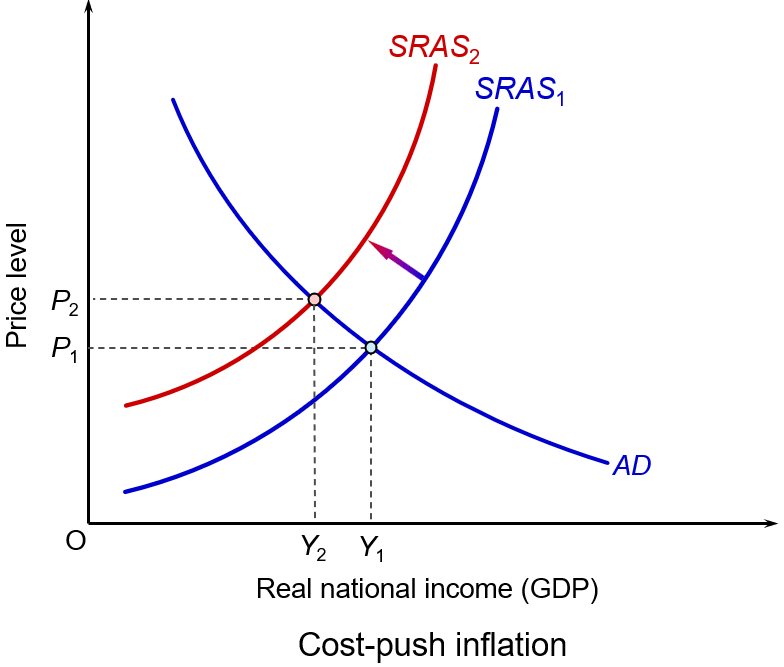 This can be illustrated with a simple aggregate demand and supply diagram. The shock shifts the aggregate supply curve upwards to the left, illustrated by the move from SRAS1 to SRAS2. The price level rises to P2 and GDP falls to Y2.
But central bank policy is designed to affect aggregate demand, not aggregate supply. If it raises interest rates, aggregate demand will shift to the left. The price level will fall (or at least the rate of inflation will fall), but output will fall further. If it cuts interest rates, aggregate demand will shift to the right. This will help to curtail, or even reverse, the fall in GDP, but will lead to even higher prices.
For countries where their central bank has a simple inflation mandate (e.g. keeping inflation close to 2%), sticking to this target in the short term would result in higher interest rates, lower economic growth and higher unemployment – and possibly even a recession. In such cases, central banks tend to project forward beyond the short-term shock and set interest rates to target inflation in a few months’ time. Indeed, many central banks do explicitly target inflation in the medium term (1 or 2 years) rather than the short term.
 Central banks, such as the US Federal Reserve Bank, which have a dual mandate of targeting inflation but also maximising employment, the trade-off between these two objectives can be stark. Getting the inflation down requires a higher rate of interest; maximising employment in the face of an adverse supply shock requires a lower rate of interest.
The short-term economic costs, let alone the human costs if the shock involves a war, can be great. People may suffer extreme hardship. The cost to the US Treasury of the first six weeks of the Iran war were estimated by the Pentagon to be some $29bn1 – which translates into higher taxes for US residents, lower government spending on non-war related items, higher government borrowing or some combination of the three. Other estimates put the cost to the US taxpayer as much higher – up to $1 trillion over the longer term.2 Then there are the costs to consumers of higher fuel and other prices, estimated at around $410 per month.3
The costs to Iranian citizens will be much higher in terms of war damage and loss of livelihood, let alone the suffering and loss of life. Then there are the costs to the rest of the world from higher prices of fuel, fertilisers and various industrial materials that are normally shipped through the Strait of Hormuz.
Long-term economic gain?
 Supply shocks often expose economic vulnerabilities that can later be addressed, making supply chains more diverse and more resilient. They can give a boost to alternative technologies, such as a switch from fossil-fuels to green energy.
After the 2007–9 financial crisis, banking systems were made more robust under the Basel III system. Capital and liquidity requirements were increased and bank leverage was decreased. Many countries, such as the UK, introduced ‘ringfencing’ to separate retail banking from the riskier investment banking. This increased confidence in the banking system.
The COVID-19 pandemic gave a boost to working remotely and the establishment of more flexible work patterns. What was a necessity during lockdowns, was seen as an effective model by many companies. Fully remote or hybrid working became commonplace for many jobs that were previously done in the office. Time has allowed employers to find the best balance of in-office and remote working, with the optimum balance often varying by type of job being performed.
The rising price of oil and gas following the Russian invasion of Ukraine in February 2022, saw many countries that had been reliant on imports from Russia, accelerating their efforts to switch to renewable energy. Supply chains were re-examined and there was a move towards ‘re-shoring’, ‘near-shoring’, or ‘friend-shoring’: that is, obtaining supplies from countries that are nearer and/or more reliable as trading partners.
 This approach was further boosted by the extensive tariffs imposed by the Trump second administration. One of the responses to the higher tariffs was to seek markets, both for exports and imports, away from the USA. To the extent that there is ‘re-shoring’ (substituting exports and imports for production and consumption within the country), then this amounts to deglobalisation. If this represents a move from low-cost to high-cost production and is contrary to the law of comparative advantage, then there will be a net economic loss. If, however, the reduction in risk of disruption and the boost to domestic industries allows a reduction in costs, there could be a net gain.
The most recent example of the Iran war has led many countries to reconsider sources of supply and to make their supply chains more robust and less risky. Gulf countries are considering expanding their pipeline network to avoid the Strait of Hormuz. For other countries, it is providing a further boost to green energy. Increased investment in the renewable sector will help to bring down costs and make countries less vulnerable to future conflicts involving oil-producing countries or sea passages.
To summarise: if initially adverse supply-side shocks cause a diversification and strengthening of supply chains, a diversification of energy sources, accelerated technological innovation and the adoption of new more efficient techniques, the long-term supply-side effects could be positive. Pain today for gain tomorrow?
But the short run comes before the long run and today’s costs are real and mounting. A shock may stimulate a positive response, but the current shock is persisting, and forecasts are getting more dire by the day. And even when the Iran war is over, there may be more shocks around the corner – ‘unknown unknowns’. As Keynes said: ‘In the long run we’re all dead’.
References
- Pentagon’s estimate for Iran war grows to $29B
Politico, Mark Sweney (12/5/26)
- World Politics The Iran war could cost the American taxpayer $1 trillion, says Harvard academic
CNBC, Joseph Wilkins (14/4/26)
- The Economic Costs of the Iran War
American Enterprise Institute, Roger Pielke Jr. (2/4/26)
Articles
Questions
- What policies have central banks pursued during the Iran war?
- Paint an optimistic scenario for the global economy five years hence.
- Paint a pessimistic scenario for the global economy five years hence.
- Compare the sources of supply of oil and gas for Europe directly prior to the Iran war with those directly prior to the Russian invasion of Ukraine.
- Compare the relative merits of globalisation and deglobalisation. Does this depend on the nature of globalisation and deglobalisation?
 During the pandemic, most people who were not furloughed were forced to work from home. After lockdown restrictions were lifted, many employers decided to continue with people working remotely, at least for some of the time.
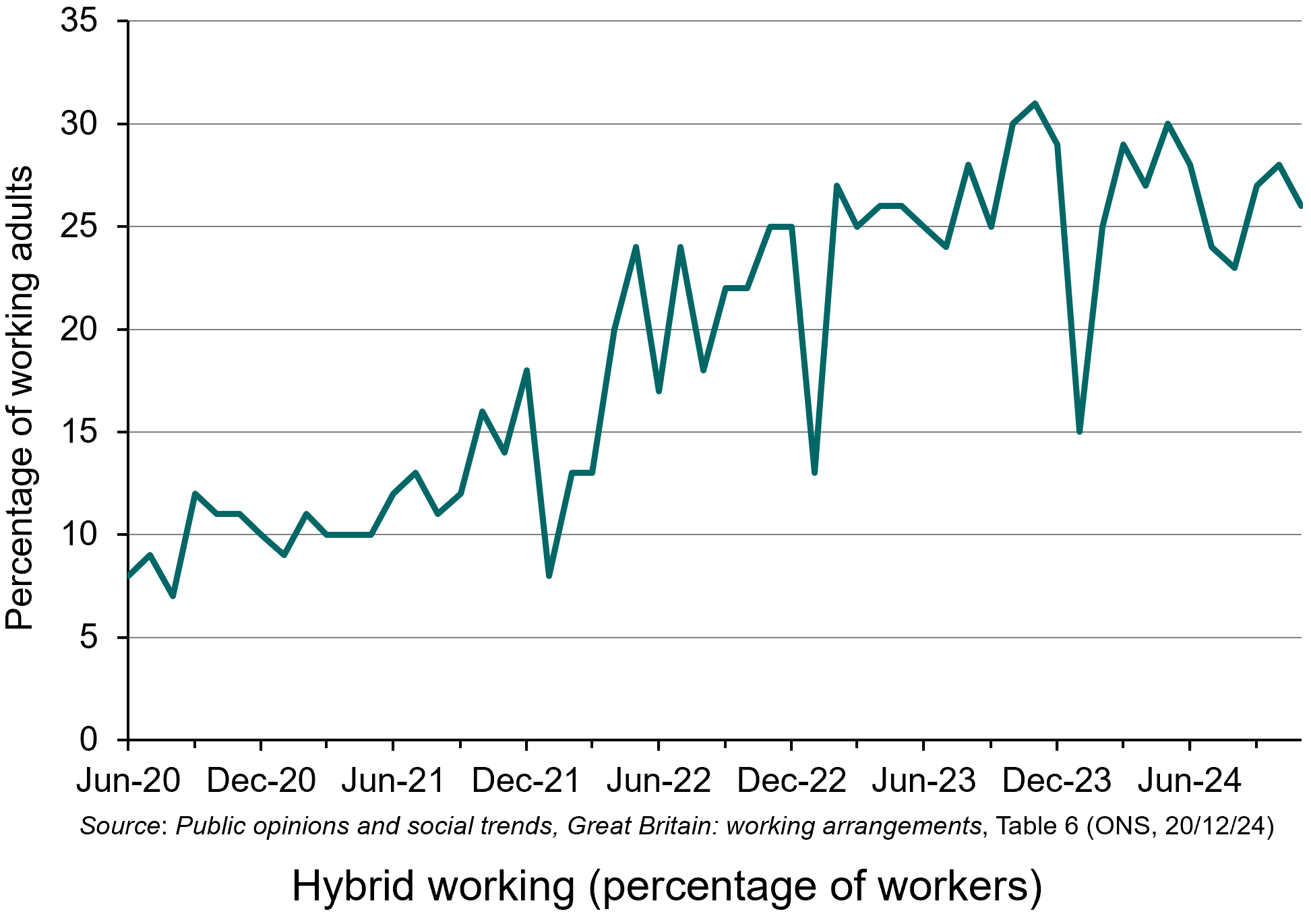
Today, this hybrid model, whereby workers work partly from home or local workspaces and partly in the office/factory/warehouse etc., has become the ‘new normal’ for around 26% of the working population in Great Britain – up from around 10% at the end of the national lockdowns in the Spring of 2021.
 Increasingly, however, employers who had introduced hybrid working are requiring their employees to return to the office, arguing that productivity and hence profits will rise as a result. Amazon is an example. Other employers, such as Asda, are increasing the time required in the office for hybrid workers.
Hybrid working had peaked at around 31% in November 2923 as the chart shows (click here for a PowerPoint). The chart is based on the December 20 database, Public opinions and social trends, Great Britain: working arrangements from the Office for National Statistics (see link under Data, below).
But why are some employers deciding that hybrid working is less profitable than working full time in the office. And does it apply to all employers and all employees or only certain types of firm and certain types of job?
The first thing to note is that hybrid work is more common among certain groups. These include older workers, parents, graduates and those with greater flexibility in scheduling their work, especially those in managerial or professional roles with greater flexibility. Certain types of work on the other hand do not lend themselves to hybrid work (or working completely from home, for that matter). Shop workers and those providing a direct service to customers, such as those working in the hospitality sector, cannot work remotely.
Benefits of hybrid working
For some employees and employers, hybrid working has brought significant benefits.
 For employees, less time and money is spent on commuting, which accounts for nearly an hour’s worth of the average worker’s daily time. According to the ONS survey, respondents spent an additional 24 minutes per day on sleep and rest and 15 minutes on exercise, sports and other activities that improved well-being compared to those who worked on-site. Working at home can make juggling work and home life easier, especially when workers can work flexible hours during the day, allowing them to fit work around family commitments.
Employers benefit from a healthier and more motivated staff who are more productive and less likely to quit. Hybrid work, being attractive to many workers, could allow employers to attract and retain talented workers. Also, employees may work longer hours if they are keen to complete a task and are not ‘clocking off’ at a particular time. Working from home allows workers to concentrate (unless distracted by other family members!).
By contrast, office working can be very inefficient, especially in open offices, where chatty colleagues can be distracting and it is difficult to concentrate. What is more, employees who are slightly unwell may continue working at home but may feel unable to commute to the office. If they did, they could spread their illness to other colleagues. Not allowing people to work from home can create a problem of ‘presenteeism’, where people feeling under the weather turn up to work but are unproductive.
One of the biggest benefits to employers of hybrid work is that costs can be saved by having smaller offices and by spending less on heating, lighting and facilities.
With hybrid working, time spent on site can be devoted to collaborative tasks, such as meetings with colleagues and customers/suppliers and joint projects where face-to-face discussion is required, or at least desirable. Tasks can also be completed that required specialist equipment or software not available at home.
Problems of hybrid working
So, if hybrid working has benefits for both employers and employees, why are some employers moving back to a system where employees work entirely on site?
 Some employers have found it hard to monitor and engage employees working from home. Workers may be easily distracted at home by other family members, especially if they don’t have a separate study/home office. People may feel detached from their co-workers on days they work from home. After a time, productivity may wane as workers find ways of minimising the amount of time actually working during declared work times.
Far from improving work-life balance, for some workers the boundaries between work and personal life can become blurred, which can erode the value of personal and family time. This can create a feeling of never escaping from work and be demotivating and reduce productivity. Employees may stay logged on longer and work evenings and weekends in order to complete tasks.
Unless carefully planned, on days when people do go into the office they might not work effectively. They may be less likely to have profitable ad hoc conversations with co-workers, and meetings may be harder to arrange. Misunderstandings and miscommunication can occur when some employees are in the office but others are at home.
Some employers have found that the problems of hybrid working in their organisations have outweighed the benefits and that productivity has fallen. In justifying its ending of hybrid working from 1 January 2025, Amazon CEO, Andy Jessy, wrote in a memo to staff in September 2024:
To address the … issue of being better set up to invent, collaborate, and be connected enough to each other and our culture to deliver the absolute best for customers and the business, we’ve decided that we’re going to return to being in the office the way we were before the onset of COVID. When we look back over the last five years, we continue to believe that the advantages of being together in the office are significant.1
But is the solution to do as Amazon is doing and to abandon hybrid working and have a mass ‘return to the office’?
Improving hybrid working
There are ways of making hybrid working more effective so that the benefits can be maximised and the costs minimised.
Given that there are specific benefits from home working and other specific benefits from working on-site, it would be efficient to allocate time between home and office to maximise these benefits. The optimum balance is likely to vary from employer to employer, job to job and individual to individual.
 Where work needs to be done in teams and where team meetings are an important element of that work, it would generally make sense for such meetings to be held in person, especially when there needs to be a lot of discussion. If the team requires a brief catch up, however, this may be more efficiently done online via Teams or Zoom.
Individual tasks, on the other hand, which don’t require consultation with colleagues or the use of specific workplace facilities, are often carried out more efficiently when there is minimum chance of interruption. For many workers, this would be at home rather than in an office – especially an open-plan office. For others without a protected work space at home or nearby, it might be better to come into the office.
The conclusion is that managers need to think carefully about the optimum distribution between home and office working and accept that a one-size-fits-all model may not be optimum for all types of job and all workers. Recognising the relative benefits and costs of working in different venues and over different hours may help to achieve the best balance, both for employers and for workers. A crucial element here is the appropriate use of incentives. Workers need to be motivated. Sometimes this may require careful monitoring, but often a more hands-off approach by management, with the focus more on output and listening to the concerns of workers, rather than on time spent, may result in greater productivity.
1Message from CEO Andy Jassy: Strengthening our culture and teams, Amazon News (16/9/24)
Articles
- Hybrid working is the ‘new normal’, according to ONS
Personnel Today, Jo Faragher (11/11/24)
- Hybrid working is here to stay but needs better managing
Business Live, Dylan Jones-Evans (18/11/24)
- The permanently imperfect reality of hybrid work
BBC: Worklife, Alex Christian (11/12/23)
- The diminishing returns of in-office mandates
BBC: Worklife, Alex Christian (12/6/24)
- The Advantages and Challenges of Hybrid Work
Gallup: Workplace, Ben Wigert and Jessica White (14/9/22)
- 9 Challenges of hybrid working and how you should tackle them
Manager Talks, Ankita (10/3/24)
- 5 Challenges of Hybrid Work — and How to Overcome Them
Harvard Business Review, Martine Haas (15/2/22)
- Post-Christmas blues as UK bosses try to turn back clock on hybrid working
The Guardian, Joanna Partridge (3/1/25)
- ‘It didn’t come as a surprise’: UK workers on being forced back into the office
The Guardian, Rachel Obordo (3/1/25)
- Amazon tells staff to get back to office five days a week
BBC News, Natalie Sherman (16/9/24)
- Inequality in flexible working dividing Britain into ‘two-tier workforce’
The Guardian, Joanna Partridge (27/1/25)
Data
Questions
- Why may hybrid working be better for (a) employees and (b) employers than purely home working or purely working in the office?
- Why are many firms deciding that workers who were formerly employed on a hybrid basis should now work entirely from the office?
- What types of job are better performed on site, or with only a small amount of time working from home?
- What types of job are better performed by working at home with just occasional days in the office?
- Does the profile of workers (by age, qualifications, seniority, experience, family commitments, etc) affect the likelihood that they will work from home at least some of the time?
- How would you set about measuring the marginal productivity of a worker working from home? Is it harder than measuring the marginal productivity of the same worker doing the same job but working in the office?
- How may working in the office increase network effects?
- How may behavioural economics help managers to understand the optimum balance of home and on-site working?