 For some people, a pint of beer is a regular thing each week. Add all your pints of beer together, then add your friend’s pints, their friends’ pints and … you get the idea. Once you’ve done that for the entire population, you have an estimate of total beer consumption in the UK. This can then be compared with total consumption of beer in other countries and between continents.
Prior to 2007, Europe and the Americas were the biggest beer drinking continents, but since then, Asia has emerged as the leader of pints of beer consumed, drinking 67bn litres of beer compared with the Americas’ 57bn and Europe’s 51bn in 2011. In per capita terms, Asia is still some way off, with Japan leading the way as the highest Asian country in 41st place, consuming 64 litres of beer per year per capita of the population. So how is this relevant to economics and business?
 Consumption of anything provides jobs – bar workers, manufacturers and in the case of beer, probably law enforcement! It probably also increases utility – after all, why consume it if it’s not going to give you some degree of satisfaction!
We can analyse the demand for beer and see how it varies with changes in price and income. Minimum prices for alcohol have been proposed as a means of reducing consumption, and tax and excise duties are always linked to alcoholic beverages and clearly have an effect on demand. In this case, however, we can also consider the emergence of Asia and how tastes have changed. It is the fastest growing beer market in the world; so what can we deduce from that? As the BBC News article states, it is ‘a sign of a young, upwardly mobile, and increasingly hedonistic population.’
Experts also say that the increased consumption of beer in Asian countries is closely correlated with growing incomes and prosperity. A consumer research analyst from Standard Chartered, Nirgunan Tiruchelvam, said:
“Beer has a clearer correlation with strong economic growth … People tend to drink beer in times of growth. They drink spirits when times are good and when times are bad.”
Data suggest that when a certain level of prosperity is reached in a nation, beer sales begin to rise. As many Asian economies begin to develop rapidly, beer sales have taken off. This could be regarded as a good thing for Europe. With stagnant Western economies, beer producers within Europe may be grateful for a growing demand in Asia. Indeed, many of the world’s biggest breweries are expanding rapidly, providing jobs and income. Consumers in Europe will also be happy to see that beer production remains profitable in other parts of the world. With unemployment still high and recession ongoing, a pint of beer will be a much needed pick-me-up for many people. At least, that’s what the evidence from the Great Depression of the 1930s suggested!!
It’s not good news for everyone, however. Beer production has also increased in Asian countries, most notably in China, which now leads the world as the largest beer producer. This clearly reduces the export potential for European beer producers.
Also, many argue that the growing consumption of beer in Asia is simply an illustration of growing Western influence and it is likely to create severe medical problems in the future. Binge drinking and under-age consumption is already a big problem in Western countries and this could soon begin to extend across the world. The following articles consider the growth in consumption of beer.
Brewers thirsty for expansion as taste for beer grows in emerging markets Guardian, Simon Neville (3/9/12)
Beer in Asia: the drink of economic growth BBC News, Saira Syed (6/9/12)
Study says world beer production hits new high Long Island Business News, Associated Press (8/8/12)
Global beer sales go up for 27th year running News Track India (9/8/12)
Questions
- Use a supply and demand diagram to analyse recent trends in beer consumption across the world.
- Which factors have caused demand in emerging markets to increase? Based on your answer to the previous question, how might that have affected equilibrium prices?
- How has growth in beer consumption throughout Asia benefited Western producers?
- What would you expect the price and income elasticities of demand to be for a product such as beer? Explain your answer.
- To what extent do you think this trend in beer production is a sign of globalisation?
- Evaluate the extent to which the growth in consumption and production of beer in Asia is a good thing. You should consider everyone who and everything might be affected!
 With droughts and poor harvests in both North America and in Russia and the Ukraine, there are worries that food prices are likely to see sharp rises in the coming months. This is clearly bad news for consumers, especially the poor for whom food accounts for a large proportion of expenditure.
But it’s also bad news more generally, as higher food prices are likely to have a dampening effect on the global economy, struggling to recover from five years of low or negative growth. And it’s not just food prices. Oil prices are rising again. Since mid June, they have risen by nearly 25%. This too is likely to have a dampening effect.
Another contributing factor to rising food prices is a response, in part, to rising oil prices. This is the diversion of land from growing food to growing crops for biofuels.
G20 countries held a conference call on 28 August to discuss food prices. Although representatives decided against an emergency meeting, they agreed to reassess the situation in a few weeks when the size of the US harvest would be clearer. If the situation proved as bad as feared, then the G20 would call an emergency meeting of the Rapid Response Forum, to consider what could be done.
But is the sole cause of rising food prices a lack of production? Are there other problems on the supply side, such as poor distribution systems and waste? And what about the role of demand? How is this contributing to long-term increases in food prices? The articles consider these various factors and what can be done to dampen food prices.
Articles
G20 points to ‘worrying’ food prices Financial Times, Javier Blas (28/8/12)
US food prices to surge on drought Gulf News(30/8/12)
Best to get used to high food and energy prices – they’re here to stay The Telegraph, Jeremy Warner (29/8/12)
Feeling a drought The Economist (14/8/12)
Q&A: World food and fuel prices BBC News (14/8/12)
 G20 considers global meeting as food prices rise BBC News (28/8/12)
Biofuels and Food Prices (direct link) BBC ‘In the Balance’ programme (25/8/12)
U.N. body urges G20 action on food prices, waste Reuters, Patrick Lannin (27/8/12)
Ethanol industry hits back over food price claims EurActiv (28/8/12)
The era of cheap food may be over Guardian, Larry Elliott (2/9/12)
Data
Food Price Index Index Mundi
Questions
- Why have food prices been rising in recent weeks?
- Use a demand and supply diagram to demonstrate what has been happening to food prices.
- What determines the price elasticity of demand for wheat? What might this elasticity vary over time?
- What is the role of speculation in determining food prices?
- Illustrate on an aggregate demand and supply diagram the effect of a commodity price shock. What is likely to be the policy response from central banks?
- What determines the price elasticity of supply of food in (a) the short term and (b) the long term?
- What determines the cross price elasticity of supply of food to the price of oil? Is the cross price elasticity of supply positive or negative?
- What can governments do to reduce food prices, or at least reduce food price inflation?
- What benefits may come from higher food and fuel prices over the longer term?
 Oil prices have been falling in recent months. By early June they had reached a 17-month low. The benchmark US crude price (the West Texas Intermediate price) fell to $83.2 at the beginning of the month, and Brent Crude (the North Sea reference price for refining into petrol) fell to $97.7 (see chart). (For a PowerPoint of the chart below, click here.)
At the same time various commodity prices have also been falling. The IMF all commodities price index has fallen by 7.2% over the past 12 months and by 6.2% in May alone. Some commodities have fallen much faster. In the 12 months to May 2012, natural gas fell by 44%, wheat by 25%, lamb by 37%, Arabica coffee by 36%, coconut oil by 45%, cotton by 47%, iron ore by 23% and tin by 29%.
Although part of the reason for the fall in the price of some commodities is increased supply, the main reason is weak world demand. And with continuing problems in the eurozone and a slowdown in China and the USA, commodity price weakness is likely to continue.
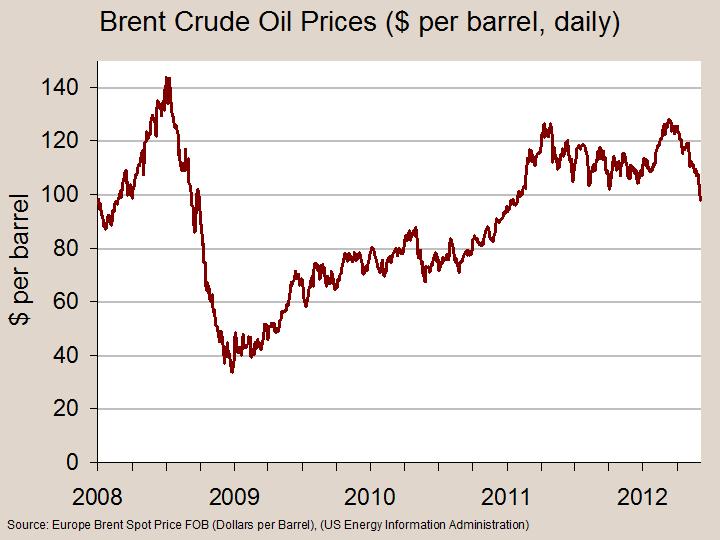 So is this good news? To the extent that commodity prices feed through into consumer prices and impact on the rate of inflation, then this is good news. As inflation falls, so central banks will be encouraged to make further cuts in interest rates (in the cases where they are not already at a minimum). For example, the Reserve Bank of Australia cut its cash rate last week from 3.75% to 3.5%. This follows on from a cut from 4.25% on 1 May. In cases where there is no further scope for interest rate cuts (e.g. the US Federal Reserve Bank, whose interest rate is between 0% and 0.25%), then the fall in inflation may encourage a further round of quantitative easing.
But falling commodity prices are also a reflection of bad news, namely the low economic growth of the world economy and fears of turmoil from a possible Greek exit from the euro.
Update
A day after this was written (9/6/12), a deal was agreed between eurozone ministers to provide support of up to €100 billion for Spanish banks. This helped to reduce pessimism about the world economy, at least temporarily. Stock markets rose and so too did oil prices, by around 1%. But if pessimism increases again, then the fall is likely to resume.
Articles
Oil prices hit a 17-month low on China slowdown fears BBC News (8/6/12)
Oil gives up gains without signs of Fed move BloombergBusinessweek, Sandy Shore (7/6/12)
Oil Heads for Longest Run of Weekly Losses in More Than 13 Years BloombergBusinessweek, (8/6/12)
Gold plunges as Bernanke gives no hint of stimulus Live5News(7/6/12)
Oil Price Tumbles Below $83 on Weak Economy Money News(8/6/12)
World food price index expected to fall for May Reuters(6/6/12)
Oil price losing streak continues Guardian, Julia Kollewe (8/6/12)
Data
Spot fuel prices US Energy Information Administration
Commodity Prices Index Mundi
Crude Oil Price Index Index Mundi
Questions
- Why have crude oil prices fallen to their lowest level for 17 months?
- How can the concepts of income elasticity of demand, price elasticity of supply and price elasticity of demand help to explain the magnitude of the fall in crude oil prices?
- Would a fall in inflation linked to a fall in commodity prices be a fall in cost-push or demand-pull inflation? Explain.
- What are the macroeconomic implications of the fall in crude oil prices?
- What factors are likely to have significant impact on crude oil prices in the coming months
- Why is it difficult to predict crude oil prices over the coming months?
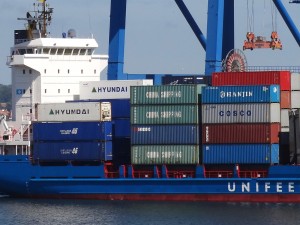 The UK’s trade deficit narrowed in March to £2.74bn from £2.95bn in February. The goods deficit fell just slightly to £8.56bn from £8.59bn, but the services surplus rose more substantially to £5.83bn from £5.64bn.
So was this a sign of the UK economy’s relative weakness holding back the demand for imports? Or was it a sign of a recovering export sector, especially in services?
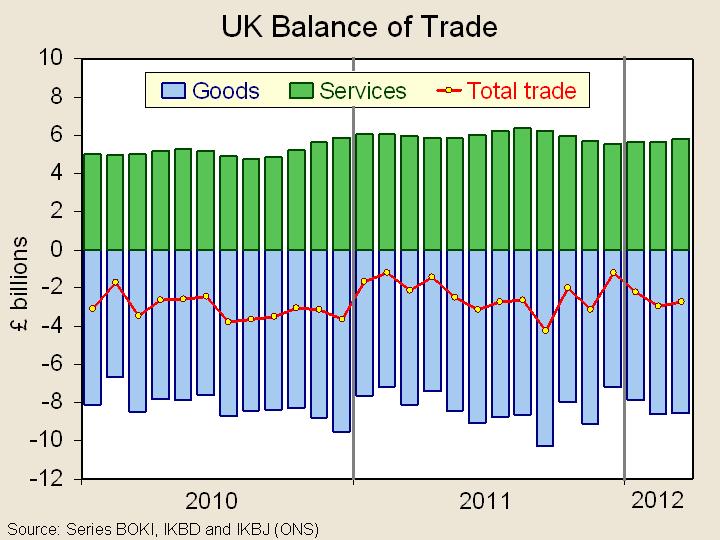 And what of the coming months? What will be the effect of a growing crisis in the eurozone on (a) the sterling exchange rate, (b) the rate of economic growth outside the UK and (c) UK economic growth? And what will be the effect of these on the demand for imports and exports and on the trade balance? The following articles examine the issues.
(For a PowerPoint of the above chart, click on the following link: Balance of trade)
Articles
UK goods trade deficit stable as exports to non-EU countries rebound Reuters (15/5/12)
UK trade deficit narrows in March to £2.7bn BBC News (15/5/12)
Exports close UK trade deficit Guardian (15/5/12)
First trade surplus in cars since 1976 The Telegraph, Emma Rowley (15/5/12)
UK trade deficit narrows in March Fresh Business Thinking, Marcus Leach (15/5/12)
ONS Release
UK Trade, March 2012 ONS Release (15/5/12)
Questions
- Distinguish between the balance on trade in goods, the balance of trade and the balance on current account.
- Why did the UK’s trade deficit fall in March 2012?
- Why did the UK experience its first trade surplus in cars since 1976?
- What is likely to happen to the UK’s balance of trade in the coming months? How is the income elasticity of demand for UK exports and imports relevant to the answer?
- What has been happening recently to the sterling exchange rate? How will this impact on the UK’s balance of trade? How will the size of this impact depend on the price elasticity of demand and supply for imports and exports?
 The Office for Budget Responsibility has said that the UK Treasury will face a shortfall of £13bn in motoring taxes within a decade. Although car usage continues to rise putting increasing pressure on the road infrastructure, the greener and more fuel efficient cars being produced are driving down the tax revenues generated from motoring.
A report by the IFS has put forward the case for replacing the existing system of taxes on cars and fuel by a new road charging system. If no such change occurs, the IFS has forecast that with more electric cars and hence lower revenues raised from fuel and vehicle excise duties, the shortfall facing the Treasury would require an increase in fuel duty of some 50%. Instead of this, the solution could be to charge individuals for every mile of road they use, with the ‘price’ varying depending on the degree of congestion. For example, at peak times the price would be higher, where as for those in the countryside where roads are traditionally much quieter, charges would be lower. The IFS said:
 ‘Such a move would generate substantial economic efficiency gains from reduced congestion, reduce the tax levied on the majority of miles driven, leave many (particularly rural) motorists better off, and provide a stable long-term footing for motoring taxes without necessarily raising net additional revenue from drivers.’
Government policy across the world has been increasingly focused on climate change, with targets for emissions reductions being somewhat ambitious. However, many car manufactures who were told to reduce emissions significantly are on the way to meeting these targets and this success is a key factor contributing towards this new road ‘crisis’ that could soon be facing the government. The following articles consider the possibility of a road charging scheme.
Report
The road ahead for motoring taxes? Institute of Fiscal Studies (link to full report at the bottom of the page) (May 2012)
Articles
Compelling case for UK road charging, IFS study says BBC News (15/5/12)
Fears tax shortfall may lead to road tolls Sky News (15/5/12)
Who’s going to pay to update Britain’s infrastructure? Guardian Business Blog (15/5/12)
Motoring taxes: a future headache for the Chancellor Channel 4 News (15/5/12)
For whom the toll bills – less traffic hurts M6 toll road owner Guardian, Ian Griffiths and Dan Milmo (14/5/12)
Charge motorists per mile, says IFS Independent, Nigel Morris (15/5/12)
Green cars to drive down tax receipts Financial Times, Mark Odell and John Reed (15/5/12)
Questions
- Illustrate the effect of a tax being imposed on petrol. What happens to the equilibrium price and quantity?
- Despite fuel duty pushing up the price of petrol, why has there been such a small decline in the quantity of petrol individuals use?
- Evaluate the case for and against a road charging scheme.
- Why are tax revenues from motoring expected to decline over the next decade?
- Climate change has become an increasingly important focus of government policy. To what extent is the current road ‘crisis’ a positive sign that policies to tackle climate change are working?
- If a road charging scheme went ahead and prices were varied depending on traffic, time etc, what name would you give to this strategy?
- Why would it be possible to charge a higher price at peak times and a lower price for cars using country roads?
- Is there an argument for privatising the road network? Is it even possible?
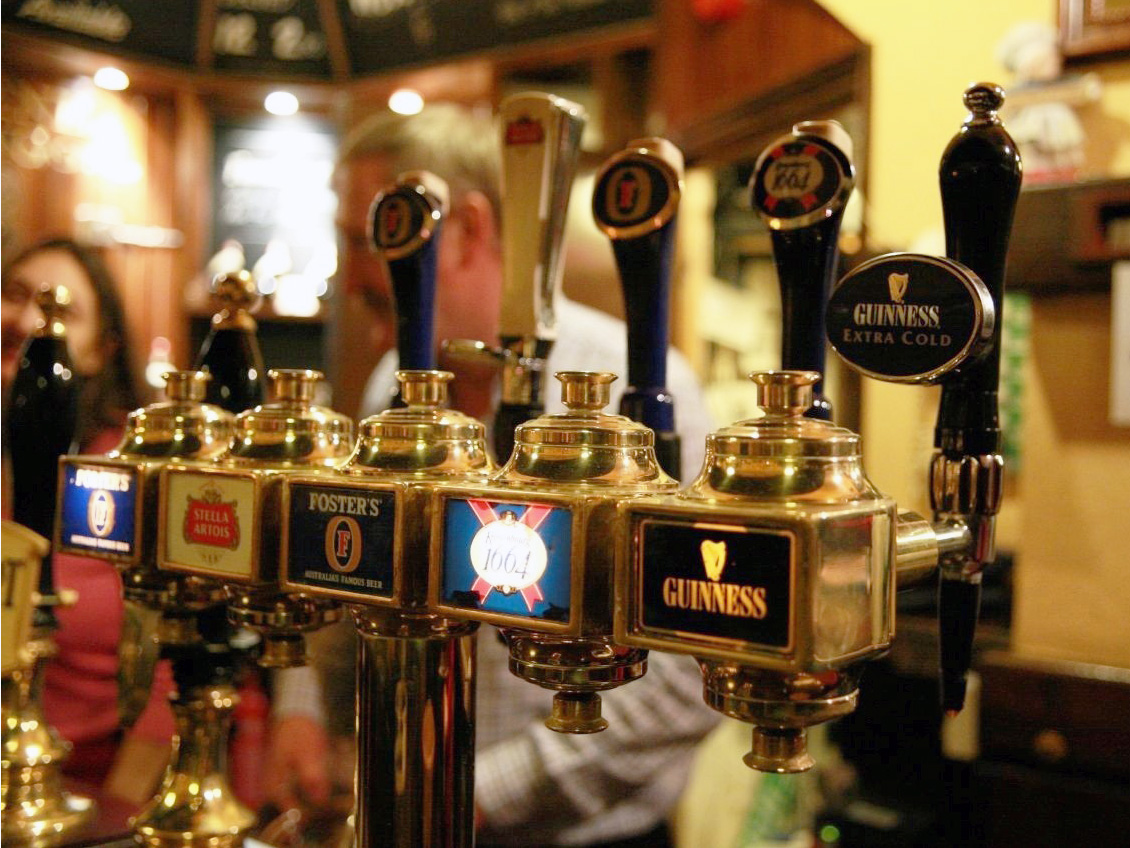 For some people, a pint of beer is a regular thing each week. Add all your pints of beer together, then add your friend’s pints, their friends’ pints and … you get the idea. Once you’ve done that for the entire population, you have an estimate of total beer consumption in the UK. This can then be compared with total consumption of beer in other countries and between continents.
 Consumption of anything provides jobs – bar workers, manufacturers and in the case of beer, probably law enforcement! It probably also increases utility – after all, why consume it if it’s not going to give you some degree of satisfaction!